Factual Matrix
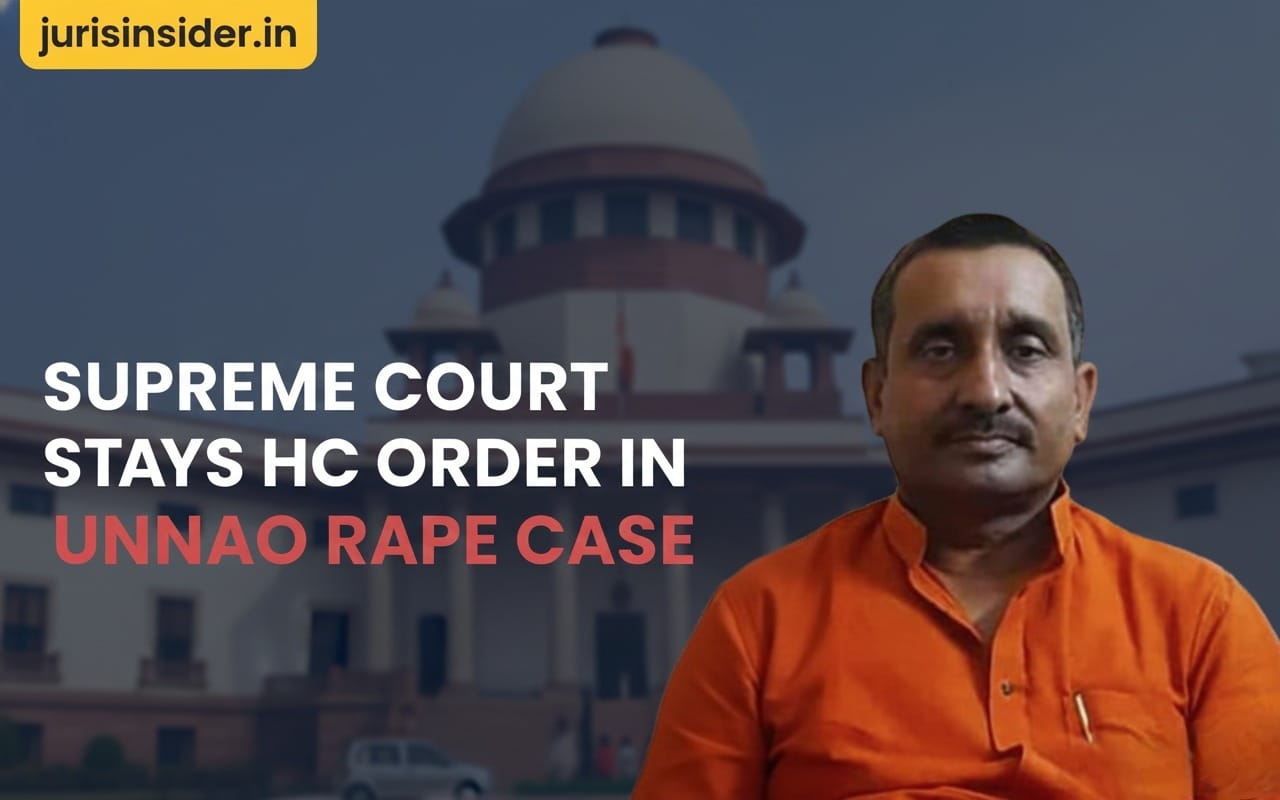
A three-judge Supreme Court panel is hearing the CBI appeal challenging the Delhi High Court order suspending former Uttar Pradesh MLA Kuldeep Singh Sengar’s life sentence for the Unnao rape.
JK Maheshwari, Augustine George Masih, and Chief Justice of India (CJI) Surya Kant are hearing the case on vacation.
CBI appealed the Delhi High Court’s December 23 verdict to postpone Sengar’s life sentence to the Supreme Court.
In December 2019, a Delhi trial court sentenced Sengar to life in jail for violating the Indian Penal Code and the Protection of Children from Sexual Offences Act.
The High Court released Sengar because the POCSO Act’s aggravated penetrative sexual assault charge was not proven.
Section 5 of the POCSO Act defines severe penetrative sexual assault of a minor. Accordingly, penetrative sexual assault becomes exacerbated if performed by a public worker, police officer inside the police station, member of the armed forces or security forces, hospital personnel, or prison staff. A minimum 20-year term and a life sentence are available for aggravated penetrative sexual assault.
The trial court penalised Sengar as a ‘public servant’ for the offence.
But according to the High Court Division Bench of Justices Subramonium Prasad and Harish Vaidyanathan Shankar, he cannot be classified as a public servant under either Section 376(2)(b) of the IPC or Section 5(c) of the POCSO Act.
The POCSO Act’s Section 5(p), which penalises an individual in a “position of trust or authority” for aggravated penetrative sexual assault, does not apply to Sengar, according to the High Court.
It led the CBI to petition the Supreme Court.
The CBI argued before the supreme court that the High Court erred in finding Sengar not guilty of aggravated penetrative sexual assault under Section 5(c) of the POCSO Act since he was not a public official.
The CBI states that a serving MLA has a constitutional position of trust and authority and performs public tasks that benefit the State and society.
The Central Bureau of Investigation (CBI) has additionally expressed apprehensions concerning the safety of the survivor and her family. The CBI maintains that, given Sengar’s influence, his release while the appeal is pending could compromise their security and erode public trust in the administration of justice.
HEARING IN DETAIL
The Supreme Court on 29.12.2025 Monday A three-judge vacation bench comprising Chief Justice of India Surya Kant, Justice JK Maheshwari, and Justice Augustine George Masih issued notice on the Central Bureau of Investigation’s (CBI) plea challenging the High Court decision.
Solicitor General Tushar Mehta, appearing for the CBI, described the matter as “a horrific case of rape of a child,” with charges framed under Section 376 of the Indian Penal Code (IPC) and Sections 5 and 6 of the Protection of Children from Sexual Offences (POCSO) Act. “Conviction is on two counts. I have quoted all relevant parts. Para 3 of my note has conviction order,” he submitted, adding that the trial court recorded a finding that the child was less than 16 years old, specifically 15 years and 10 months, with an appeal pending against the conviction.
(Mehta argued that penetrative sexual assault is an independent offence under POCSO, and aggravated forms apply where the perpetrator is in a dominant position, such as a public servant, police constable, or army officer on duty.) He contended that the definition of “public servant” must be contextual and that an MLA exercising dominance over a constituent seeking help would qualify for aggravated provisions.
Justice JK Maheshwari noted, “Section 376 had been dealt with.”
SG Mehta responded that Section 376 has two parts, including rape by a person in a dominant position, carrying a minimum sentence of 20 years extending to life.
CJI Surya Kant observed, “You say it falls under 376(2)(i)… Assuming victim is not a minor… even then minimum sentence to 376(2)(i) will apply…”
Mehta highlighted post-amendment enhancements to minimum sentences.
Justice Maheshwari pointed out, “Amendment was not there when the commission of offence was there. So (i) was applicable as it then existed.”
CJI Kant asked, “Are you saying concept of public servant is irrelevant if the victim is a minor?”
Mehta replied affirmatively, explaining that aggravated sexual assault categories include dominant positions and that Section 42A of POCSO prevails in case of divergence with other laws. He urged stay of the High Court order, noting Sengar’s separate conviction for murdering the victim’s father.
Senior Advocate Siddhartha Dave, for one of the parties, referred to Section 2(2) of POCSO.
CJI Kant remarked, “But if conviction is under two penal statutes and High Court proceedings only under POCSO… Sentencing was granted only because he fell under definition of public servant.”
The bench indicated, “Tentatively, we are inclined to stay the order. Generally, the principle is since the person has walked out, the court does not take away the liberty. But here, the situation is peculiar since he is inside the jail for another case.”
Justice Maheshwari asked counsel to show where the High Court considered Section 376(2)(i).
CJI Kant expressed concern over the POCSO definition of public servant, stating, “We are worried that a constable shall be a public servant under the Act, but an MLA will be excluded!”
Senior Advocate N Hariharan, appearing for Sengar, argued that a penal statute cannot import definitions from another statute.
The bench ultimately held: “Issue notice. We have heard SG Mehta for CBI and seniors for the convict. We find that there are various substantial questions of law that arise. Counter to be filed in 4 weeks. We are conscious of the fact that when convict or undertrial has been released, such orders are not ordinarily stayed by this court without hearing such persons. But in view of peculiar facts where convict is convicted for a separate offence, we stay operation of Delhi High Court order dated December 23, 2025. Thus respondent (Sengar) shall not be released pursuant to the said order.”
Sengar remains in custody due to his ongoing sentence in the separate case related to the custodial death of the victim’s father. The matter is likely to be listed next in January 2026.