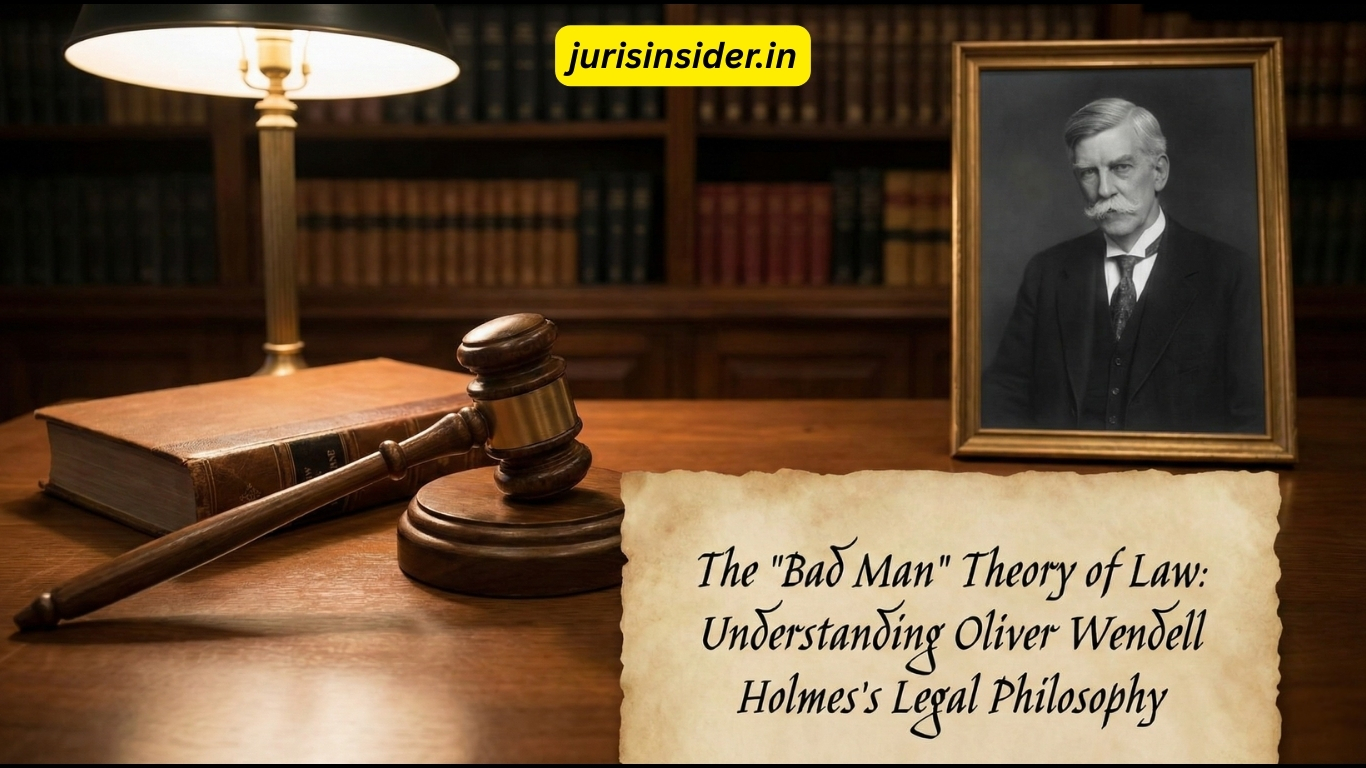
Introduction to Oliver Wendell Holmes’s “Bad Man” Theory
Oliver Wendell Holmes Jr., a distinguished American jurist and Supreme Court Justice, introduced the “bad man” theory in his influential 1897 speech, The Path of the Law. This concept, thoroughly examined by Sanford Levinson and J.M. Balkin in their 1998 article “The Bad, The Good, and the Self-Reliant” (78 B.U. L. Rev. 885), provides a pragmatic and positivist perspective on law. Holmes’s “bad man” metaphor has sparked significant debate, shaping legal scholarship by prioritizing the practical consequences of law over moral considerations. This article explores the nuances of the “bad man” theory, its critiques, its connection to Emersonian self-reliance, and its lasting impact on legal thought, offering a comprehensive analysis for scholars, students, and practitioners.
What is the “Bad Man” Theory? OR What Did Holmes Mean by the “Bad Man”?
Holmes’s “bad man” theory proposes that to understand law, one should adopt the perspective of a “bad man”—an individual who cares solely about the material consequences of legal rules, such as fines or imprisonment, and disregards moral or ethical obligations. Holmes describes the “bad man” as someone who “cares nothing for an ethical rule which is believed and practised by his neighbors” but is highly motivated to avoid financial penalties or jail time. This approach strips law of its moral veneer, focusing on its operational meaning—how it influences behavior through enforceable sanctions.
In contrast, Holmes portrays the “good man” as someone driven by conscience, adhering to the law due to moral convictions rather than fear of punishment. However, the “bad man” theory asserts that viewing law through the lens of someone indifferent to morality offers clearer insight into its practical application. This aligns with legal positivism, which separates law from morality, treating it as a system of rules enforced by state authority. By emphasizing the “bad man,” Holmes challenges traditional views that link law to moral virtue, urging lawyers to focus on how law functions in practice.
The Context of Holmes’s Legal Philosophy
Holmes delivered The Path of the Law in 1897, during an era when legal formalism dominated, viewing law as a coherent system of principles derived from precedent. Influenced by the emerging legal realism movement, Holmes rejected this perspective, advocating a pragmatic approach that emphasized law’s real-world effects. His theory was not intended to define the “essence” of law but to serve as a practical tool for lawyers advising clients on the consequences of their actions. The “bad man” metaphor was a provocative way to shift focus from abstract legal doctrines to the tangible impact of law on behavior.
Holmes’s rejection of natural law, which holds that laws derive legitimacy from moral truths, shaped his philosophy. He saw law as an instrument of state power, functioning as a “pricing system” that incentivizes or deters behavior through sanctions. This instrumental perspective contrasts with views of law as a protector of individual rights or a system of logical doctrines, positioning Holmes as a precursor to modern legal realism. His focus on predictability and consequences reflects a practical concern for how law operates in the lives of individuals and society.
Critiques of the “Bad Man” and Predictive Theory
Despite its influence, the “bad man” metaphor has faced significant criticism. Levinson and Balkin argue that it is a “bad metaphor” because it conveys a misleading attitude toward law and may conflict with Holmes’s broader views on law, morality, and individual agency. Critics have often portrayed Holmes as an “insensitive moral skeptic” who reduced law to raw power, a caricature that oversimplifies his complex philosophy. This perception arises from the metaphor’s focus on a morally indifferent figure, which seems to dismiss the role of ethics in legal understanding.
A major critique is that the “bad man” metaphor oversimplifies human motivation. Levinson and Balkin note that Holmes’s psychological model is limited, as both the “bad man” and the “good man” are driven by sanctions—material for the former, conscience-based for the latter. This blurs the distinction between the two, suggesting that the “good man” is merely a “bad man” motivated by non-legal sanctions, such as guilt or fear of divine punishment. Such a framework fails to capture the complexity of human behavior, where motivations often blend self-interest and morality.
Additionally, the metaphor struggles to address unjust laws. Holmes acknowledged that law and morality can diverge, as seen in historical examples like the Fugitive Slave Act of 1850, which mandated the return of escaped slaves. A “bad man” might exploit such laws for personal gain, while a “good man” might defy them out of moral conviction, complicating the idea that the “bad man” alone provides insight into law’s practical workings. This limitation suggests that a broader perspective, incorporating both moral and pragmatic considerations, is necessary to fully understand law.
The Role of the “Good Man” in Holmes’s Theory
Holmes’s reference to the “good man” is crucial to understanding the “bad man” theory. The “good man” obeys the law out of conscience, not merely to avoid punishment. However, Levinson and Balkin highlight a paradox: if the “good man” obeys just laws due to moral alignment, what happens when laws are unjust? They cite examples like assisted suicide, where legal prohibitions may conflict with moral imperatives, challenging the notion that obedience to law is inherently virtuous. A doctor in a state banning assisted suicide might face a moral dilemma, questioning whether compliance with the law outweighs a patient’s suffering.
This interplay between the “good man” and the “bad man” reveals that both consider the consequences of their actions, albeit for different reasons. The “good man” may disobey unjust laws, just as the “bad man” may obey laws that serve their interests, undermining the idea that the “bad man” alone offers a unique perspective on law. This suggests that understanding law requires accounting for both egoistic and moral motivations, challenging the simplicity of Holmes’s original metaphor.
Emersonian Self-Reliance: A Better Lens for Holmes’s Philosophy
Levinson and Balkin propose replacing the “bad man” metaphor with the concept of the “self-reliant individual,” inspired by Ralph Waldo Emerson’s essay Self-Reliance. Holmes was deeply influenced by Emerson, describing him as the “firebrand” of his youth and a lasting inspiration. The authors argue that an Emersonian reading of The Path of the Law better captures Holmes’s broader philosophy, emphasizing individual autonomy and skepticism toward conventional morality.
Emerson’s self-reliant individual rejects societal norms and laws that conflict with personal integrity, as evidenced by his fierce opposition to the Fugitive Slave Act, which he deemed an “immoral law.” Similarly, Holmes’s disdain for outdated legal precedents—“It is revolting to have no better reason for a rule of law than that so it was laid down in the time of Henry IV”—echoes Emerson’s rejection of unthinking reverence for the past. The self-reliant individual considers legal consequences but prioritizes personal values, whether they align with or oppose the law.
This perspective reframes Holmes’s theory as a call for critical thinking about law, rather than a mere focus on material incentives. It highlights the tension between state authority and individual autonomy, a central theme in both Emerson’s and Holmes’s thought. By viewing law through the lens of self-reliance, Holmes’s philosophy becomes a challenge to question authority and evaluate laws based on personal moral judgment.
The Predictive Theory of Law and Its Limitations
Holmes’s “bad man” theory is closely tied to his predictive theory of law, which views law as a system of predictions about how courts and authorities will act. The “bad man” uses law to anticipate consequences, treating it as a “pricing system” for behavior. However, Levinson and Balkin argue that this theory is incomplete, as it fails to account for morally motivated disobedience, such as civil disobedience against unjust laws. For instance, an opponent of slavery might refuse to return a fugitive slave, just as a conscientious objector might evade an unjust war.
The predictive theory assumes that “bad” people are more likely to break the law, but the authors challenge this, noting that “good” people may also defy laws they deem unjust. This suggests that understanding law’s practical application requires considering both egoistic and moral motivations for compliance or defiance. The theory’s focus on predictability overlooks the complex interplay of values and incentives that shape how individuals interact with the legal system.
The “Bad Man” and State Power
Holmes’s “bad man” theory aligns with an instrumental view of law, where the state uses laws to shape behavior through incentives and punishments. From the state’s perspective, the “bad man” is predictable, responding to sanctions like fines or jail time. However, Levinson and Balkin argue that this view prioritizes state power over individual autonomy, treating citizens as objects of governance rather than moral agents. The state prefers citizens who view law as self-justifying or who can be easily manipulated through incentives, as they are easier to control.
By contrast, the self-reliant individual challenges state authority by questioning the moral legitimacy of laws. Emerson’s condemnation of the Fugitive Slave Act as an “immoral law” reflects this defiance, as does his support for figures like John Brown, who resisted unjust laws through radical action. Holmes’s own skepticism of legal formalism suggests a preference for individuals who think critically about law, rather than blindly obeying it. This tension between state power and individual autonomy underscores the limitations of the “bad man” metaphor and the value of the self-reliant perspective.
Implications for Legal Education and Practice
Levinson and Balkin argue that the “bad man” metaphor, while provocative, can mislead students and practitioners by focusing solely on material consequences. They advocate teaching law through the lens of the self-reliant individual, who weighs both legal and moral consequences in decision-making. This approach encourages lawyers to advise clients not just on avoiding punishment but on navigating the ethical complexities of legal systems.
For example, in cases involving assisted suicide or civil disobedience, lawyers must consider clients’ moral motivations alongside legal risks. By emphasizing self-reliance, legal education can foster critical thinking about law’s role in society, aligning with Holmes’s broader call to question authority and conventional norms. This perspective prepares lawyers to address the moral dilemmas that arise when laws conflict with personal or societal values, promoting a more nuanced approach to legal practice.
The Legacy of Holmes’s “Bad Man” Theory
Holmes’s “bad man” theory remains a cornerstone of legal realism, influencing modern legal thought by emphasizing law’s practical effects over abstract principles. Its focus on material consequences has shaped fields like law and economics, where laws are analyzed as incentive structures. The theory’s emphasis on predictability and pragmatism has made it a foundational concept for understanding how law operates in practice.
However, its limitations, as highlighted by Levinson and Balkin, have sparked ongoing debates about the relationship between law and morality. The Emersonian perspective offers a more nuanced legacy, portraying Holmes as a thinker who valued individual autonomy and skepticism. By celebrating the self-reliant individual, Holmes’s philosophy encourages a critical approach to law that resonates with contemporary debates about justice, ethics, and state power. This dual legacy—pragmatic yet morally engaged—ensures that Holmes’s ideas continue to influence legal scholarship and practice.
Conclusion: Reframing Holmes’s Vision
Oliver Wendell Holmes’s “bad man” theory, while a groundbreaking contribution to legal positivism, is an imperfect metaphor that oversimplifies the complex interplay between law, morality, and individual agency. Levinson and Balkin’s critique reveals that the “good man” and the self-reliant individual offer richer perspectives for understanding law’s role in society. By drawing on Emersonian self-reliance, they reframe Holmes’s philosophy as a call to question authority, prioritize personal integrity, and navigate the moral complexities of legal systems.
The “bad man” theory remains a vital tool for understanding law’s practical consequences, but its limitations highlight the need for a broader approach that incorporates moral and ethical considerations. As legal scholars and practitioners continue to grapple with issues like unjust laws and civil disobedience, Holmes’s legacy—viewed through an Emersonian lens—offers a compelling framework for fostering critical, autonomous, and ethical engagement with the law. This vision, rooted in skepticism and self-reliance, ensures that Holmes’s ideas remain relevant in addressing the challenges of modern legal systems.
References
- Sanford Levinson & J.M. Balkin, The Bad, The Good, and the Self-Reliant, 78 B.U. L. Rev. 885 (1998).
- Oliver Wendell Holmes, The Path of the Law, 10 Harv. L. Rev. 457 (1897).
- Ralph Waldo Emerson, Self-Reliance, in Essays and Essays: Second Series 35-73 (Morse Peckham ed., 1969).
- Ralph Waldo Emerson, The Fugitive Slave Act, in The Selected Writings of Ralph Waldo Emerson 566 (Brooks Atkinson ed., 1990).
- Ralph Waldo Emerson, John Brown, in Selected Writings of Ralph Waldo Emerson 879-882 (Brooks Atkinson ed., 1990).
FAQ on The “Bad Man” Theory of Law
- 1. What is Oliver Wendell Holmes's "Bad Man" Theory of Law?
- 2. How does the "Bad Man" theory reflect legal positivism?
- 3. What is the difference between the "Bad Man" and the "Good Man" in Holmes’s theory?
- 4. What are the main critiques of the "Bad Man" theory of law?
- 5. How is Emerson’s concept of self-reliance connected to Holmes’s legal thought?
- 6. What is the predictive theory of law and how is it related to the Bad Man theory?
- 7. . Why is the "Bad Man" metaphor considered problematic in modern legal education?
- 8. What impact has Holmes’s "Bad Man" theory had on modern legal thought?
- 9. Can unjust laws be understood using the "Bad Man" theory?
- 10. What is the legacy of the "Bad Man" theory in legal practice?